
Mentioning the Big Five usually brings to mind the vast plains of Kenya or Tanzania. In contrast, Uganda is often known for its mountain gorillas, iconic mist-covered landscapes, and chimpanzee trekking.
Yet Uganda is also one of the few countries in Africa where visitors can experience the Big Five alongside a remarkable variety of other wildlife encounters. Over the course of a single journey, you might watch elephants gathering along the Nile, search for lions on the savannah, track rhinos on foot, and spend an hour in the company of wild mountain gorillas.
For travellers looking for a safari that offers more than a checklist of famous animals, Uganda has a great deal to offer. We hope the following blog gives you plenty of inspiration for your future travels. If you would like to consider travelling with Home to Africa, please explore our Safaris in East Africa.

What Are the Big Five?
The term “Big Five” dates back to the colonial hunting era and referred to the five animals considered the most difficult and dangerous to hunt on foot: the lion, leopard, elephant, buffalo, and rhinoceros.
Today, thankfully, the phrase has taken on a very different meaning. Rather than trophies, these animals are among Africa’s most sought-after wildlife sightings, and seeing all five remains a highlight for many safari-goers.
Uganda is home to each member of the Big Five, although some are easier to find than others.

The African Lion
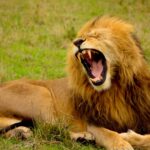
Few wildlife sightings create the same sense of excitement as seeing lions in the wild.
Uganda’s best-known lion population lives within Queen Elizabeth National Park, particularly in the Ishasha sector, where some lions have developed the unusual habit of climbing and resting in large fig trees. The sight of a lion stretched across a branch several metres above the ground is something many visitors remember long after their safari ends.
Lions are also found in Murchison Falls National Park and Kidepo Valley National Park. Early morning game drives often provide the best opportunities, when prides are still active before the heat of the day arrives. (Learn about visiting Murchison Falls National Park with Home to Africa.)
As apex predators, lions play an important role in maintaining healthy ecosystems, helping regulate populations of grazing animals throughout Uganda’s savannah landscapes.
The African Elephant
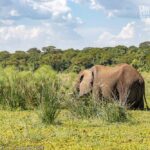
The African elephant is the largest land animal on Earth, and Uganda offers plenty of opportunities to encounter them.
Large herds can be found in Murchison Falls National Park and Queen Elizabeth National Park, often moving between grasslands, woodlands, and water sources in search of food. Unlike some safari destinations where wildlife viewing is centred entirely on vehicle-based game drives, Uganda’s waterways often provide particularly memorable elephant sightings.
A cruise along the Kazinga Channel or the Victoria Nile may bring visitors surprisingly close to elephants drinking at the water’s edge or crossing between feeding grounds.
Watching a family group move together across the landscape is a reminder of the intelligence and social bonds for which elephants are renowned. You can visit the Queen Elizabeth National Park with us; if you have any questions, please get in touch.

The Cape Buffalo
Buffalo rarely receive the same attention as lions or elephants, but they deserve respect.
Capable of weighing well over half a tonne, the Cape buffalo is regarded as one of Africa’s most formidable animals. Herds numbering in the hundreds are a common sight in Queen Elizabeth National Park, while Murchison Falls and Kidepo also support healthy populations.
Buffalo often appear calm, standing quietly in open grassland or cooling themselves in muddy pools. Their reputation comes from their unpredictability when threatened. For this reason, experienced guides always treat them with caution.
For photographers, large buffalo herds can make for some of the most striking scenes on safari, particularly when dust rises around them during the dry season.
The African Leopard
If there is one member of the Big Five that tests a safari-goer’s patience, it is the leopard. Unlike lions, which often live in visible social groups, leopards are solitary and elusive. They spend much of their time concealed in thick vegetation or resting high in trees during daylight hours.
Leopards can be found in several of Uganda’s national parks, including Queen Elizabeth, Murchison Falls, Lake Mburo, and Kidepo Valley. Experienced guides know where to look for clues, whether that is fresh tracks along a road or the alarm calls of antelope hidden nearby.
The reward for persistence may be the sight of one of Africa’s most beautiful predators emerging from the shadows.

The Rhino: Uganda’s Conservation Success Story
Rhinos occupy a unique place in Uganda’s wildlife story. Unlike the other members of the Big Five, rhinos disappeared entirely from Uganda’s national parks during the political instability and heavy poaching of the 1970s and 1980s. For many years, the country had no wild rhino population at all.
The turnaround began with the establishment of Ziwa Rhino Sanctuary, located between Kampala and Murchison Falls National Park. Through careful conservation efforts and breeding programmes, the sanctuary has helped restore rhinos to Uganda after decades of absence.
Today, visitors can join guided walking excursions to observe white rhinos at close range. It is a very different experience from a traditional game drive and often becomes one of the most memorable moments of a safari.
Uganda’s rhino story entered a new chapter in 2026 when rhinos began returning to Kidepo Valley National Park, marking the first stage of a long-term effort to restore the species to its historic range.
For many travellers, seeing a rhino in Uganda is not only a wildlife encounter but also a glimpse of conservation in action. Find out about seeing rhinos with Home to Africa, explore our 12-day customised safari tour in Uganda, which features a visit to the Ziwa Rhino Sanctuary.
Where Can You See the Big Five in Uganda?
Most Big Five safaris in Uganda combine several locations. Murchison Falls National Park offers excellent opportunities to see lions, elephants, buffalo, and leopards. Queen Elizabeth National Park provides similar opportunities, with the added attraction of its famous tree-climbing lions.
Kidepo Valley National Park, located in Uganda’s remote northeast, is often considered one of Africa’s most spectacular safari destinations and supports four of the Big Five species.
Rhinos are most reliably seen at Ziwa Rhino Sanctuary, which is conveniently located along the route to Murchison Falls and is often included in safari itineraries.
Together, these destinations allow visitors to complete their Big Five checklist while experiencing some of Uganda’s most diverse landscapes.
More Than a Big Five Safari
The Big Five may attract visitors to Uganda, but they are rarely the whole story. One of the country’s greatest strengths is the variety of experiences available within a single journey. A traveller who begins by searching for lions on the savannah may later find themselves tracking chimpanzees through tropical forest, cruising past hippos on the Nile, or standing face-to-face with mountain gorillas in Bwindi Impenetrable National Park.
These different experiences complement one another. Wildlife remains at the heart of the journey, but it is accompanied by landscapes, cultures, and encounters that create a deeper understanding of East Africa. For that reason, many visitors leave Uganda remembering far more than the animals they came to see.
Planning a Big Five Safari in Uganda
Uganda offers one of Africa’s most rewarding wildlife experiences, combining iconic safari species with attractions found nowhere else on earth.
Whether your goal is to see all five members of the Big Five, track mountain gorillas, or build a journey that combines several regions of the country, careful planning can make all the difference.
At Home to Africa, we create tailor-made safaris shaped around your interests, pace, and travel style. Contact our team to start planning your Uganda safari adventure.