
An African safari cost in 2026 usually sits between $180 and $1,800 per person per day on the ground in East Africa, and the spread is explained by camp type, season, park fees, and whether you drive or fly between parks.
Most first quotes look high because they bundle things people assume are extras: the Land Cruiser, the guide who grew up reading these tracks, full-board meals, and the government fees that keep the parks staffed. Strip those out and you are not comparing safaris. You are comparing a bed to a week in the bush.
This budget guide is written from the itineraries Home to Africa builds every week in Uganda, Rwanda, Kenya, and Tanzania. The numbers are planning ranges in US dollars, per person sharing, excluding international flights. When you are ready to turn a range into a dated quote, the team answers first inquiries within 60 minutes and builds the trip around your pace, not a template.

So what does the cost look like
For a seven- to ten-day East African safari in 2026, most travellers we plan for land in one of four bands. Budget camping or simple lodges run about $1,400 to $2,800 per person. Mid-range private-vehicle trips, the lane most couples and small families choose, run $3,500 to $7,000. Luxury lodges and fly-in camps sit at $8,000 to $16,000. Ultra-luxury and exclusive-use camps start around $18,000 and climb from there.
A mid-range week in Uganda that includes one gorilla permit often comes in cheaper than the same length of time in the northern Serengeti in August. Kenya usually undercuts Tanzania at the same lodge standard because you can cover more parks by road and you avoid some of TANAPA’s higher daily fees. Rwanda is a short, expensive, tightly run gorilla chapter, not a cheap savannah week.
A useful planning rule: budget $400 to $750 per person per day if you want a private 4×4, a mid-range lodge or tented camp, all meals, park fees, and a driver-guide who stays with you. That is the African safari price most first-time visitors actually pay in 2026.
What the safari price covers
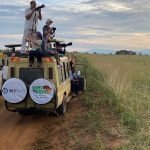
A serious quote should name what is in and what is out. If it does not, ask. The ground price we work from usually includes accommodation on a full-board basis, a dedicated safari vehicle, a driver-guide, park and conservancy fees for the days you are inside the gates, bottled water, and airport or airstrip transfers inside the itinerary.
It does not include the international flight into Entebbe, Nairobi, Kilimanjaro, or Kigali. It does not include travel insurance, visas or eTAs, alcoholic drinks at most mid-range properties, tips, laundry, or optional extras such as a hot-air balloon over the Serengeti or Mara. Gorilla and chimpanzee permits are itemised separately so you can see the government line, then folded into the trip total.
Park fees are paid to the authority that runs the gate, not to the lodge. In Uganda that is the Uganda Wildlife Authority. In Kenya’s national parks it is KWS; in the Maasai Mara National Reserve it is Narok County. In Tanzania, TANAPA collects for Serengeti, Tarangire, and Manyara, while the Ngorongoro Conservation Area Authority collects for the crater and the Ndutu plains that sit inside its boundary. Mixing those names on an invoice is how a cheap quote quietly becomes a cash collection at the gate.
African safari cost by travel style
Style is the largest lever after destination. The animals do not change much between a $220 camping night outside the Mara and a $1,400 conservancy suite. The vehicle, the crowding, the food, and how early you can leave camp do.
| Style | Per person / day | 7-day trip (pp, ex-flights) | What you actually get |
|---|---|---|---|
| Budget / value | $180 – $350 | $1,400 – $2,800 | Shared or simple private vehicle, basic lodge or public campsite, set menus, longer driving days |
| Mid-range | $400 – $750 | $3,200 – $6,500 | Private 4×4, en-suite tent or lodge, full board, named guide, park fees in the quote |
| Luxury | $800 – $1,800 | $7,000 – $15,000 | High-end camp, often fly-in, smaller guest numbers, private or semi-private guiding |
| Ultra-luxury | $1,800 – $3,500+ | $16,000 – $30,000+ | Exclusive-use or flagship camps, specialist guides, airstrip-to-airstrip routing |
Mid-range is where most of our private trips live, and for good reason. You sleep in a proper bed. You eat three meals that were cooked for the table in front of you. You do not share the vehicle with six strangers whose timetable is not yours. Luxury buys space, speed between parks, and camps that sit inside private conservancies where night drives and walking are legal. Ultra-luxury buys silence. Decide which of those you actually want before you chase a nightly rate.

African safari cost by country
East Africa is not one price list. Uganda sells diversity and a gorilla hour. Kenya sells density and shorter road days. Tanzania sells scale and the Serengeti–Ngorongoro circuit. Rwanda sells a short, high-specification gorilla trek an hour and a half from Kigali.
Uganda
A seven-day mid-range Uganda safari in 2026 typically costs $3,500 to $5,500 per person sharing, including one standard gorilla permit. Budget versions that sleep in simpler lodges and drive every sector can come in around $2,200 to $3,200. Luxury fly-in circuits with high-end Bwindi lodges and a night in Kidepo run $7,500 to $14,000.
The permit is the line everyone stares at. Uganda Wildlife Authority charges foreign non-residents $800 for a standard one-hour trek in Bwindi or Mgahinga, dropping to $600 in April, May, and November. The Gorilla Habituation Experience in Rushaga is $1,500 through June 2026 and is widely quoted at $1,800 from 1 July 2026. Kibale chimpanzee tracking sits at $200 to $250. Savannah parks such as Murchison Falls, Queen Elizabeth, Lake Mburo, and Kidepo charge $40 to $45 per foreign adult per day. That combination, gorilla plus Big Five plus the Nile, is why Uganda still offers more kinds of day for the money than any neighbour.
Kenya
A seven-day mid-range Kenya safari in 2026 typically costs $3,800 to $6,500 per person. A focused three-night Mara add-on from Nairobi can be planned from about $1,800 in green season and $2,600 to $4,600 in July to October, depending on camp. Luxury conservancy stays (Naboisho, Mara North, Olare Motorogi) push a week past $10,000 without trying.
The fee that changed behaviour this year is the Maasai Mara National Reserve ticket. Narok County charges non-resident adults $100 per 12-hour day from January to June and $200 from July to December. Children aged 9 to 17 pay $50. Under-eights enter free. Conservancies charge their own nightly conservation fees on top, which is the trade you make for fewer vehicles at a sighting. KWS parks such as Amboseli, Nakuru, and Nairobi keep flatter year-round structures and are useful ballast when the Mara is at the $200 rate.
Tanzania
A seven-day mid-range Northern Circuit safari (Tarangire, Ngorongoro, Serengeti) in 2026 typically costs $4,000 to $7,000 per person sharing. Budget camping versions start around $1,800 to $3,000. Luxury fly-in camps in the northern Serengeti during river-crossing weeks regularly quote $12,000 to $20,000. Distances are the hidden cost. Arusha to central Serengeti is a long road day, which is why so many quotes add a light-aircraft hop and why Tanzania often prices above Kenya at the same lodge standard.
TANAPA conservation fees for a non-resident adult are commonly budgeted at about $70 to $83 per 24 hours in Serengeti, with a concession fee around $60 when you sleep inside the park. Tarangire and Lake Manyara sit closer to $50 to $60. Ngorongoro, run by NCAA rather than TANAPA, is about $71 per adult per day, plus a crater descent fee of $295 per vehicle. Quotes that swap the Serengeti and Ngorongoro figures, or leave VAT off the government lines, are the ones that grow at the gate.
Rwanda
Rwanda is a compact, premium gorilla trip more than a classic multi-park safari. A three- to four-day Volcanoes National Park itinerary in 2026 typically costs $3,000 to $5,500 per person at mid-range, and $6,000 to $12,000 at the top lodges, because the Rwanda Development Board permit is $1,500 for foreign non-residents. A promotional $1,050 rate can apply from November to May when the trek is combined with at least two nights in Akagera or Nyungwe. East African citizens pay $200. African residents pay $500. Daily capacity across the habituated families is tightly capped, which is why peak dates still book many months out.
| Country | 7-day mid-range pp | 7-day luxury pp | Cost driver to watch |
|---|---|---|---|
| Uganda | $3,500 – $5,500 | $7,500 – $14,000 | Gorilla permit $800 / $600 low season |
| Kenya | $3,800 – $6,500 | $9,000 – $16,000 | Mara fee $100 Jan–Jun, $200 Jul–Dec |
| Tanzania | $4,000 – $7,000 | $10,000 – $20,000 | Serengeti fees + flight vs road |
| Rwanda (3–5 days) | $3,000 – $5,500 | $6,000 – $12,000 | Gorilla permit $1,500 / $1,050 promo |

How does it all add up
Four costs do most of the work: the bed, the government ticket, the vehicle, and the season. Everything else is noise until those four are honest.
Park fees and permits, 2026
| Ticket | Authority | 2026 foreign adult rate | Notes |
|---|---|---|---|
| Uganda gorilla trek | UWA | $800 ($600 Apr/May/Nov) | One hour, max 8 visitors, non-reschedulable once paid |
| Uganda gorilla habituation | UWA | $1,500 (rising mid-year) | Rushaga only, longer encounter |
| Kibale chimpanzee trek | UWA | $200 – $250 | Half-day forest walk |
| Uganda savannah parks | UWA | $40 – $45 / day | Murchison $45; QENP, Mburo, Kidepo $40 |
| Maasai Mara Reserve | Narok County | $100 / $200 per 12 hrs | Jan–Jun low; Jul–Dec high |
| KWS parks (indicative) | KWS | Park-specific | Amboseli, Nakuru, Nairobi stay flatter year-round |
| Serengeti NP | TANAPA | $70 – $83 / 24 hrs | Plus concession fee if you sleep inside |
| Ngorongoro CA | NCAA | ~$71 / day + $295 / vehicle | Crater descent is a separate vehicle fee |
| Rwanda gorilla trek | RDB | $1,500 ($1,050 promo) | Promo needs extra nights in Akagera or Nyungwe |
Vehicle, guide, and flying versus driving
A private Land Cruiser with a driver-guide, fuel, and park vehicle fees typically costs $180 to $350 per day depending on country and whether the vehicle stays overnight in the park. Split two ways that is manageable. Split four ways it is one of the cheapest upgrades you can buy. Shared group trucks look cheaper on paper and cost you hours at every sighting.
Internal flights change the shape of a Tanzania or Uganda itinerary more than they change the animal list. Entebbe to Kihihi or Kisoro for Bwindi runs about $250 to $450 a leg. Arusha or Kilimanjaro into the Serengeti is a similar band. You pay to buy back a day that would otherwise be spent on a corrugated road. For a seven-day trip that day is often worth more than the ticket.
Season
Season is not weather copy. It is inventory. July to October camps in the northern Serengeti and the Mara raise rack rates because the migration is on their doorstep and every tent is sold. January and February in Ndutu do the same thing for calving. April, May, and November drop both lodge rates and, in Uganda, the gorilla permit. The animals are still there. The trails are wetter and the dining tents are quieter.

African safari cost by month
Use the table as a pricing climate, not a promise. Figures are mid-range daily planning rates per person sharing for a typical East African itinerary (private vehicle, full board, park fees in). Uganda gorilla weeks add the permit on top. Peak means camps and gates are expensive. Value means the same animals at a kinder rate.
| Month | What the month is doing | Mid-range daily pp | Price climate |
|---|---|---|---|
| January | Short dry. Ndutu calving. Firm Bwindi trails. Festive tail. | $550 – $850 | High |
| February | Calving continues. Good light. Still busy in the south Serengeti. | $550 – $850 | High |
| March | Rains building. Shoulder rates start. Birding strong. | $450 – $700 | Shoulder |
| April | Long rains. Quiet camps. Uganda gorilla permit $600. | $380 – $620 | Lowest |
| May | Rains easing late month. Space at briefings and gates. | $380 – $650 | Low |
| June | Long dry opening. Herds tightening. Rates climbing. | $500 – $780 | Rising |
| July | Mara fee jumps to $200. Northern Serengeti demand spikes. | $650 – $1,000 | Peak |
| August | River crossings in focus. Highest lodge rates of the year. | $700 – $1,100 | Peak |
| September | Still peak in Mara and north Serengeti. Slightly more lodge space. | $650 – $1,000 | Peak |
| October | Herds begin to turn south. Rates high until mid-month. | $600 – $950 | High |
| November | Short rains. Uganda gorilla permit $600. Good lodge value. | $420 – $680 | Low |
| December | Short dry returns. Festive surcharges from mid-month. | $550 – $900 | High |
If the question is how to lower an African safari cost without dropping the country you came for, move the month before you move the lodge. April and May in Uganda still put you in front of a habituated family at the $600 permit. November does the same, and the forest is a deeper green. June in the Mara still uses the $100 reserve ticket, and late June can catch early herds without the August rack rate. February in Ndutu is not a cheap month, but it is the month the plains fill with calves, and that is a different product from a July crossing.
Sample 2026 budgets we actually build
These are composite itineraries, not live invoices. They assume two adults sharing, mid-range lodges unless noted, park fees included, international flights excluded.
Uganda, 8 days: gorillas, Queen Elizabeth, Kibale
Two nights Entebbe or Kampala on arrival and departure buffers, two nights Bwindi (Buhoma or Rushaga), two nights Queen Elizabeth, one night Kibale. One gorilla permit at $800, one chimpanzee permit at $250, private 4×4 throughout. Mid-range total: $4,200 to $5,800 per person. Swap April or November and the permit drops $200. Add a fly-in to Kihihi and you spend $300 to $450 to cut a seven-hour road day.
Kenya, 7 days: Amboseli and the Mara
One night Nairobi, two nights Amboseli, three nights Mara. Private vehicle. In January to June, mid-range sits around $3,600 to $5,200 per person because the Mara ticket is $100. The same bones in August land at $5,000 to $7,200 once lodge rack rates and the $200 ticket stack. A conservancy camp instead of a reserve camp adds a nightly conservation fee and subtracts vehicles at the sighting.
Tanzania, 8 days: Tarangire, Ngorongoro, central Serengeti
Road circuit from Arusha. Mid-range: $4,400 to $6,800 per person. Park and crater fees alone often account for $500 to $700 of that. Fly the last hop into the Serengeti and the total climbs $400 to $700 while the trip loses a dusty afternoon. Put the same week into a northern Serengeti mobile camp in August and you are quoting luxury numbers even if the canvas looks modest.
Uganda and Rwanda, 6 days: two gorilla hours
One trek in Bwindi at $800 and one in Volcanoes at $1,500, with a land crossing through Cyanika or Katuna. Mid-range: $5,500 to $7,500 per person. You are paying for two regulated hours and the logistics that connect them, not for eight game drives. Home to Africa handles both permits and the border handoff from one desk, which is the point of a locally owned operator that works both sides.
What sits outside the quote
International flights into the region in 2026 commonly add $700 to $1,800 per person from Europe and $1,200 to $2,400 from North America, depending on season and how many stops you will accept. Kenya’s eTA is $30. Tanzania and Uganda visas vary by nationality and are best checked on the official portals rather than a forum thread from 2023.
Tips are customary and should be planned, not improvised at the airstrip. A working range is $10 to $20 per person per day for a driver-guide on a private trip, plus $5 to $10 per person per day shared among lodge staff, and a separate envelope for the gorilla trek porter ($15 to $25) and ranger team. Balloons over the Mara or Serengeti are quoted around $500 to $600. Laundry, premium wine, and souvenir markets are the only other lines that regularly surprise people who packed well.
A portion of every Home to Africa booking is directed to local communities and wildlife conservation. That is already inside the trip price. It is not a checkout add-on.
How to hold the budget without shrinking the trip
Travel with two or four people, not as a solo passenger in a six-seater Cruiser. The vehicle cost is largely fixed. Share it.
Pick one country and stay. A seven-day Uganda trip that does Bwindi, Queen Elizabeth, and Kibale spends more hours with animals than a seven-day itinerary that also tries to add the Mara. Borders take a day. Days are what you flew here to use.
Use the low-fee months on purpose. April, May, and November in Uganda. January to June in the Mara if river crossings are not the picture in your head. Late October in the northern Serengeti if you can live with the herds beginning to turn.
Ask what the quote does with park fees. If they are “collected in the park,” you do not have a complete African safari price. You have a deposit.
Book gorilla permits as soon as the dates are real. UWA has required full payment at booking for 2026 permits, and the discounted $600 tickets cannot be moved. A permit you do not hold is not a plan.
FAQ: African safari cost 2026
How much does an African safari cost in 2026?
Plan $180 to $350 per person per day for budget, $400 to $750 for mid-range, $800 to $1,800 for luxury, and $1,800-plus for ultra-luxury fly-in camps. A typical seven-day mid-range trip in East Africa costs $3,500 to $7,000 per person sharing, excluding international flights. That is the honest planning band for African safari cost 2026.
How much does a 7-day African safari cost?
A 7-day African safari cost in 2026 runs about $1,400 to $2,800 per person on a budget camping or simple-lodge trip, $3,200 to $6,500 mid-range, and $7,000 to $15,000 at luxury camps. Uganda weeks that include a gorilla permit sit inside the mid-range band more often than people expect. Tanzania peak-migration weeks sit above it.
How much does a safari cost per person per day?
African safari price per day in 2026 is best thought of as all-in on the ground: bed, meals, vehicle, guide, and park fees. Under $350 is budget. $400 to $750 is the mid-range daily rate most private trips use. Above $800 you are in luxury inventory, and above $1,800 you are paying for exclusivity and aircraft.
How much does a Uganda gorilla safari cost?
A Uganda gorilla safari cost in 2026 starts with the UWA permit at $800, or $600 in April, May, and November. Add two lodge nights, transfers, and the trek-day costs and a short gorilla-only trip can be planned from about $1,800 to $3,000 per person mid-range. Folded into a seven-day country circuit, the full trip usually lands between $3,500 and $5,500.
Is Rwanda gorilla trekking more expensive than Uganda?
Yes, on the permit alone. Rwanda charges $1,500 for foreign non-residents against Uganda’s $800, with a conditional $1,050 promotional rate in the green months. The walk from the Volcanoes briefing area is often shorter. The hour with the family is the same regulated hour. Many travellers trek Uganda for value and add Rwanda when they want a second family without a second long road.
How much are Maasai Mara park fees in 2026?
Non-resident adults pay $100 per 12-hour day from 1 January to 30 June and $200 from 1 July to 31 December. Children aged 9 to 17 pay $50. Under-eights are free. Conservancy fees are separate and charged per night by each conservancy, not by Narok County.
How much are Serengeti and Ngorongoro fees in 2026?
Budget Serengeti at roughly $70 to $83 per non-resident adult per 24 hours, plus a concession fee if you sleep inside the park. Budget Ngorongoro at about $71 per adult per day plus $295 per vehicle for the crater descent. Child rates and VAT treatment should be visible on the invoice. If they are not, ask.
Does African safari cost include flights?
Almost never the international flight. Regional hops between Entebbe and Bwindi, or Arusha and the Serengeti, are sometimes inside a fly-in quote and sometimes listed as extras. Read the inclusions paragraph. If “flights” is not named, assume you are buying them yourself.
What is the cheapest time for an African safari in 2026?
April, May, and November are the value months across East Africa. Lodge rates ease, camps have space, and Uganda’s gorilla permit drops to $600. You trade firmer trails and bigger skies for rain and, in some parks, thicker grass. For many travellers that is a good trade.
Why do two quotes for the same dates differ by thousands?
Because one is a shared truck and a lodge outside the park, and the other is a private vehicle and a camp inside a conservancy. Because one left park fees out. Because one put you on the road for two days the other put on a twelve-seater Cessna. Same country, same week, different product. Compare inclusions, not headlines.
Can I do an African safari on a mid-range budget with children?
Yes, with age rules in mind. Gorilla trekking has a minimum age of 15. Many walking activities start at 12. Game-drive itineraries in Kenya and Tanzania work well for families from about six, and child park-fee rates cut the government line. Family rooms and connecting tents exist in mid-range inventory if you ask before the lodge is held.
How far in advance should I book a 2026 safari?
Peak July to October dates in the Mara and northern Serengeti, and dry-season gorilla permits in Bwindi, should be held six to nine months out, earlier for flagship camps. Green-season dates can be planned on a shorter fuse, but discounted gorilla permits still need to be paid immediately. First inquiries to Home to Africa are answered within 60 minutes so you can hold a date while you think.
Plan the trip at the price you actually want
An African safari cost is not a single sticker. It is a set of choices you can see: country, month, bed, vehicle, and which government tickets you will pay. Once those are named, the quote stops feeling like a fog and starts feeling like a week you can picture.
Tell us the month you can travel, the animals you will not compromise on, and the number you want to stay near. We will send back a dated itinerary with the park fees and permits on the page, built by a locally owned team that works Uganda, Rwanda, Kenya, and Tanzania as one map. First reply within an hour. The rest is the trip.
Request a custom 2026 safari quote at hometoafrica.com. Bring the month. We will bring the numbers.